Drones circled as colleagues sheltered in Lebanon
Zeinab Faraj survived a missile strike that killed reporter Amal Khalil and two municipal officials traveling with them.
By Mariam Darwish ·
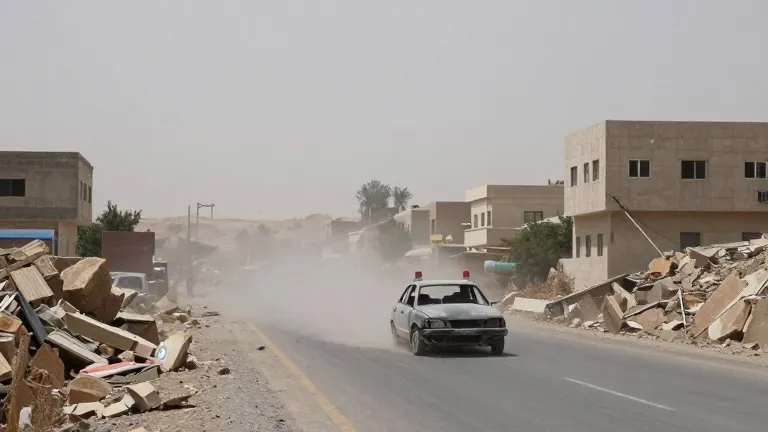
The first missile struck the car ahead on the road to al-Tiri on 22 April, killing the two men inside it. Zeinab Faraj, a 21-year-old photojournalist, and Amal Khalil, a 42-year-old newspaper reporter, stepped from their own vehicle and watched the wreckage burn. Faraj never heard the incoming round. She heard Khalil scream.
Faraj and Khalil had set out together that afternoon to document what remained of villages flattened during a month of airstrikes in southern Lebanon. Israel had agreed to a ceasefire in mid-April, and residents were moving south to inspect damage. Faraj, finishing a degree in radio and TV while freelancing, expected the outing to be routine. "I had absolutely no sense of fear," she said, describing gunfire and artillery as sounds she wanted on tape.
The car in front carried Ali Nabil Bazzi, 27, a municipal official in Bint Jbeil, and Mohammed Hourani, 37, a friend of the mayor. The four had met by chance earlier that day at Tebnine governmental hospital, a site regarded as safe. Bazzi was due to sign a marriage contract that evening but joined the trip anyway. Both men died when their vehicle was hit.
Drones arrived low over the road afterward. Faraj said one passed close enough that she raised a hand to shield her face, and it climbed each time she moved. Emergency services told the pair by phone that help was coming, assurances Faraj compared to an anaesthetic. A paramedic then instructed them to drive back up the road because ambulances could not reach them. Their car was struck by a missile as they moved toward it.
Both women were thrown backward, and Khalil wrapped her arms around Faraj. Khalil said she hoped the drone would "think we were dead." They took shelter in a nearby house. Khalil bled from her face, hand and leg and could not walk. Faraj sent one message to her sister before the phone died: "There's no hope left. Forgive me."
A drone descended sharply while Faraj watched the road. A missile followed with a sound she said she had never heard. She woke beneath rubble, breathing with difficulty. Paramedics cleared debris and pulled her out while drones circled overhead; she said a stun grenade was dropped nearby. In the ambulance she mistook the engine noise for an aircraft.
Khalil had died roughly an hour before rescuers were permitted to return to the area and reach Faraj. The Israeli military said its personnel had identified saboteurs breaking the ceasefire. Human rights groups called the strikes a war crime and noted repeated messages sent to the military asking it to allow rescue while the women were inside the building. A week before the attack, an Israeli military spokesperson had shown a video of Khalil published by her newspaper and called it "terrorist media." Khalil had also received death threats from Israeli numbers.
Faraj is preparing to return to university. She walks with difficulty, her hand shows injury, and a facial wound limits movement in one eyebrow. She wakes at night screaming, and drones put her on edge. She is haunted by Hourani on the ground, his eyes open and looking at her.
Source: The Guardian