Israel Faces Complex Parliamentary Vote
Voters choose parties in a 120-seat parliament, setting the stage for months of coalition negotiations.
By Mariam Darwish ·

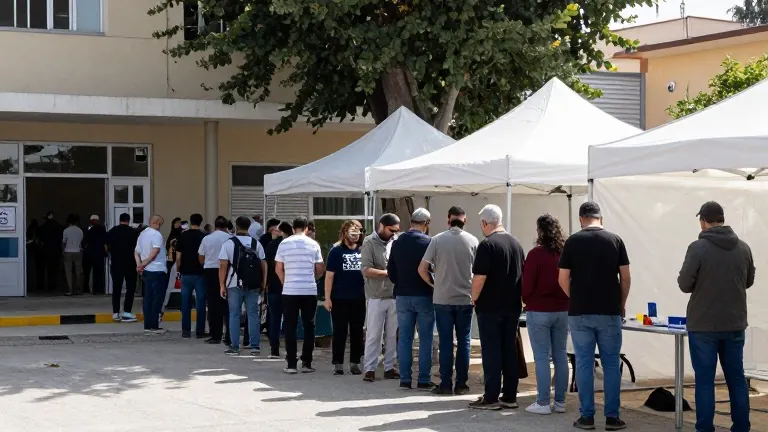
Israelis are heading to the polls on Tuesday, October 27, 2026, to select members of the 120-seat Knesset. The election follows more than three years of regional conflict and war, including the Hamas-led attacks of October 7, 2023, and subsequent fighting in Gaza, Lebanon, Iran, Syria, and Yemen. Prime Minister Benjamin Netanyahu is seeking another term, but recent polls place him behind his main challenger, former military chief Gadi Eisenkot.
The vote is indirect. Citizens will cast ballots for one of a dozen major parties rather than choosing a prime minister directly. The contest shifts to coalition building after election day, as party leaders attempt to assemble a governing majority of at least 61 lawmakers. Neither Netanyahu nor Eisenkot currently commands a clear path to that threshold, leaving the final outcome dependent on post-election negotiations that may last weeks or months.
Netanyahu, the country's longest-serving prime minister, leads the most right-wing government in Israel's history. His current coalition includes Itamar Ben-Gvir, Bezalel Smotrich, and two ultra-Orthodox parties. He campaigns on military achievements and his relationship with President Donald Trump, who recently endorsed him. Netanyahu has also made confronting Iran a central campaign goal. Eisenkot, leading the new center-right party Yashar, seeks to replace him. His son, Gal, was killed in Gaza during the war. Eisenkot has pledged not to join a government led by Netanyahu.
Two predominantly Arab parties are running, including the United Arab List, or Ra'am. This group became the first Arab Islamist party to join a governing coalition in 2021. It says it is willing to work with Jewish parties on issues such as crime, housing, and infrastructure. However, most major Jewish parties, including Eisenkot's Yashar, remain reluctant to rely on Arab parties for a majority. This hesitation could leave the anti-Netanyahu camp without the 61 seats required to govern.
Key issues include accountability for the October 7, 2023 attack, in which about 1,200 people were killed and 251 were taken hostage. Netanyahu has resisted calls for a state commission of inquiry, while Eisenkot and other opposition leaders promise to establish one quickly. The election also addresses military service exemptions for ultra-Orthodox Jewish men. Netanyahu has resisted enlisting them, relying on their political support, whereas Eisenkot campaigns to expand their service. Additionally, voters are weighing the power of the judiciary. Netanyahu's government previously pursued a judicial overhaul that triggered large protests, and he remains on trial for corruption. He calls the charges politically motivated, while Eisenkot advocates for an independent court system.
Post-election scenarios vary. Eisenkot's allies might form a minority government with support from Arab parties, despite campaign promises. Alternatively, Netanyahu and Eisenkot could form a unity government, though Eisenkot has publicly ruled this out. Another possibility is a plea deal where Netanyahu steps down in exchange for dismissed criminal charges. A deadlock could leave Netanyahu as a caretaker prime minister, leading to a repeat election next year. Even if Eisenkot cannot form a government immediately, a parliamentary majority opposed to Netanyahu could elect a new Knesset speaker and advance legislation on military service.
Netanyahu's Likud party is already promoting a scenario where the election was stolen if a coalition fails to form, a move that could lead to instability. Neither candidate currently supports the immediate establishment of a Palestinian state. Their differences center on democratic institutions, the West Bank, and international relations. Netanyahu's far-right partners support settlement expansion and have pushed for annexation, drawing sanctions from the U.K. and Europe. Eisenkot presents a more pragmatic alternative, opposing violence by settlers and construction in the E1 area east of Jerusalem, which critics say would divide the West Bank.
The vote determines not only who leads the country but also the direction of Israel's institutions and alliances. It is a contest over leadership, accountability for the recent war, the role of religion in the state, and the independence of courts. The results will dictate whether Israel pursues a right-wing or center-right path in the coming years.
Source: Connecticut Public Television · original report published
More World · Bridgeport news · Report a business · Got a Story?